
Probably.
The images Retina produces for planning applications — the CGI showing a new bespoke dwelling situated in a rural setting, the montage of a barn conversion in a Lincolnshire village, the cross-section through a listed theatre — are typically described as ‘supporting documentation’. They’re presented as evidence, not advertising.
But are they neutral?
They were commissioned because a design team want the planning application to succeed. And the images are made to help make that case. So what exactly is the difference between that and marketing?
The image is always making an argument.
Every decision that goes into a CGI intended for a planning submission — the viewpoint, the time of day, the way the context is framed — is a choice. None of it is accidental, and none of it is truly neutral.
A standalone CGI of a proposed dwelling is, at its core, asking the viewer to imagine something that doesn’t exist yet. To picture the building as a real thing in the world. To feel something about it.
That is precisely what marketing does.
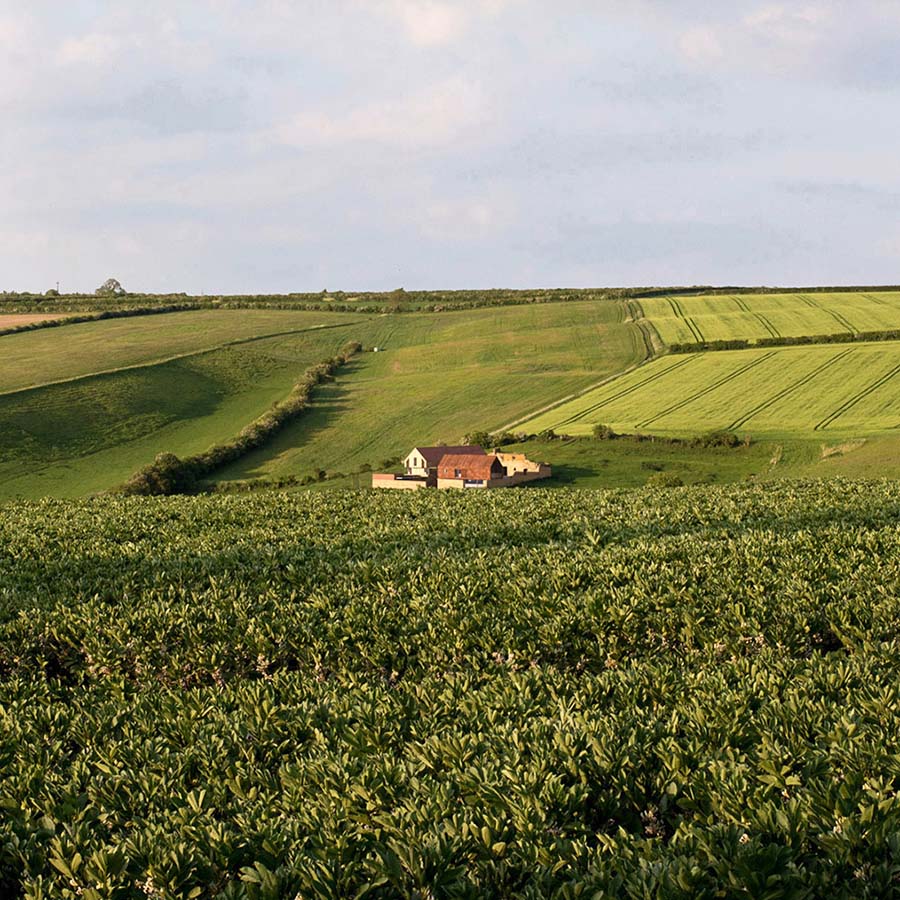
Where it gets more interesting is when you start to think about what happens when those images have to hold up to scrutiny. Because they do.
Exaggeration doesn’t survive contact with people who are familiar with the context. So the discipline the planning process imposes on these images is its own kind of quality control.
Photomontages, Verified Views, AVRs.
This is where things get more demanding.
With a standalone CGI, you’re building a whole world from scratch. You control the light, the context, the atmosphere. There’s creative latitude.
With a photomontaged image, you’re placing or compositing, a computer generated render of a proposal into a baseline photograph of the existing site. The camera, of course, ‘doesn’t lie’. It shows exactly what’s there — the texture of the existing brickwork, the way the light hits the street in November, the geometry and massing of the neighbouring buildings, albeit within the distilled reality of photography.
And the computer generated imagery of the proposed intervention has to sit inside all of that without looking out of place.
I’ve been doing this for a long time. Prior to Retina, I was involved in some large London planning submissions — One Hyde Park, St Giles’ Court, Walbrook Square — back when the production of accurate visual representations was still being formalised as a methodology. Those projects were scrutinised extraordinarily carefully, together with a method statement detailing the processes employed. Camera positions were surveyed. Lens characteristics were documented. The process was, in some ways, closer to a surveying exercise than a creative one.
And that level of rigour made sense, because the stakes were high and the images could be presented as evidence in public inquiries.
The methodology for smaller schemes may or may not so elaborate, but the underlying principle is identical.
In practice this means a few things. The baseline photograph needs to be taken from a documented position — GPS coordinates, measured height, a calibrated lens so you can match the field of view exactly in 3ds Max (or whatever modelling software you’re using). You note the time, the weather, the season. All of that affects the lighting situation, and the light on the 3D model of the proposal has to match.
Then you build the 3D model, position it accurately, sometimes within a digital replica of the surrounding context, set up the lighting to correspond with what was happening when the photograph was taken, and render.
And then comes the compositing process, typically within Photoshop — matching colour temperature, atmospheric haze, the slight grain or artifacts of the original photograph.
If any of those things are off, it shows. Sometimes subtly, sometimes obviously, but it always shows. And it always raises the question: what else has been fudged?
Photo-montaging is, in a way, an honest form of planning representation — not because it’s somehow free of advocacy, but because the discipline required to produce a credible one forces accuracy.
So. Is it marketing?
Yes. I think so.
A CGI produced for planning application purposes is commissioned, and indeed created, by a team who wants the scheme to succeed, to communicate its qualities to a local authority charged with the decision on whether the proposal satisfies local and indeed national Planning Policy, and thus grant permission.
That is a form of marketing.
But it’s marketing with specific constraints that most marketing briefs don’t have. It has to be accurate. It has to hold up to expert scrutiny. It has to function as evidence in a formal process. And in the case of photomontage, it has to coexist within the distilled and restricted gamut of photography.
Those constraints don’t make it neutral but they do make it defensible.
I think that’s actually a reasonable thing for a visual to be. An honest advocate with the supporting methodology provided.
If you’re working on a planning application and want to talk through what’s needed, please get in touch.
Alternatively, if you’re curious about how we use CGI earlier in the process — before the photomontage stage — there’s more on that here.
The question of AI imagery in this context is its own conversation — we’ve written about that separately